
The BARLOG Plastics diary
Read more
Small steps lead to big success – smartphone stands with a focus on DoE
Through the targeted use of simulations and statistical test planning (DoE), the BARLOG Plastics smartphone stand was optimized in terms of warping behavior and mechanical strength during the virtual development phase. Critical weak points such as weld lines and support warping were identified, eliminated through minimally invasive geometric adjustments, and the final tool concept was defined at an early stage. This resulted in a high-quality, functional product solution with minimal effort and a great show effect.
Project description: Component and requirements
The development department at BARLOG Plastics developed the smartphone stand as a display stand for mobile phones with added functional value (speaker amplifier) from the initial idea to series production. As part of this development, the design and manufacturing-specific details were optimized with the help of simulations. The scope of the simulation was automated using statistical test planning/design of experiments (DoE).
Challenges:
- Dependencies: In order to prevent all possible sources of error in preparation for the plastic injection molding manufacturing process and in the application, the article underwent an iterative development process in the CAE department at BARLOG Plastics. The challenge here was to take into account the dependencies between the individual disciplines and to optimize them in a simulation sequence that was as automated as possible.
- Mechanical stress: It quickly became apparent that mechanical stress on the front bracket of the smartphone stand would cause the component at the end of the flow path to fail. This weak point in the material structure is caused by a weld seam that is located precisely in a highly stressed area. Since this weld seam cannot be avoided due to the geometry, it must be moved out of the critical area by optimizing the geometry of the article itself.

Fig. 1: Bonding seam at the end of the flow path (left) and weak points in gray (right)
- Warpage behavior: The initial injection molding simulations also provided insights into warpage behavior, which also had to be optimized, as otherwise the stand could wobble on the desk. Here, the connection position was found to have a significant influence on warpage behavior. The results of the injection molding simulation, in conjunction with the critical points identified in the structural simulations, provided valuable insights into strength and warpage behavior.
Solution approaches and process design
Various approaches were pursued in a full factorial DoE (design of experiments) for the simulative review and optimization of the critical points.
1.Identification of the connection position:
To identify the connection position with the lowest tendency to warp, the connection was varied across the component side in line with the mold concept. To this end, 20 different injection points and their effects were included in the test plan.

Fig. 2: The injection point was varied at intervals of 2.5 mm along the mold parting line.
- Position of the binding seam
To influence the position of the binding seam, the development engineers pursued two approaches in parallel: On the one hand, by increasing the wall thickness in the arch step by step by 1 mm in order to increase stiffness and promote material flow in this area (flow aid). Second, a pocket recessed into the underside of the component at varying depths in 0.2 mm increments slows down the flow of material (flow brake).

Fig. 3: Arch with increased wall thickness (left) and pocket on the underside of the component (right)
- Redesign
In order to evaluate the interdependencies and influences of the individual changes, the redesigns were carried out in a detailed test plan. In this full factorial DoE, all variants could be simulated, compared, and evaluated according to the set target values. The target variables are the position of the binding seam and the flatness of all contact points, i.e., the distortion of the component.
Several measuring points on the underside of the component, which should ideally lie on a single plane, define this distortion. Minimizing component distortion ensures good stability.
To evaluate the second target value, the “position of the bonding seam,” the number of particles colliding is counted in the critical area of the strength calculation. The lowest value indicates that a bonding seam can be avoided in the defined area.
This means that input variables based on the different geometric variants and the target variables relating to component quality are included in the test plan.

Fig. 4: Definition of target values: Flatness on the underside (left) and no binding seam in the critical area (right).
Results and findings
The given input variables, the various injection points, the flow aid in the arch, and the flow brake in the floor result in a full factorial test plan with 180 different combinations for the simulation. All combinations are output with the resulting values of the target variables, i.e., the warpage and the position of the weld seam.
In order to visualize and evaluate the dependencies of the individual input variables on each other, the entire experimental design is displayed in a parallel coordinate diagram. This visualization illustrates the spread resulting from the combination of input variables. In a conventional development phase, a large number of confusing combinations would be run through in a time-consuming and cost-intensive process until the desired result is achieved.

Fig. 5: Full display of the calculation results in the parallel coordinate diagram.
By simply limiting all measurement results to a target range, the combinations with the most promising results can be identified in the calculation results.

Fig. 6: Reduced parallel coordinates
From all 180 possible combinations, the best combination of minimal warping tendency and avoidance of weld lines in critical areas was quickly identified. The location of the connection and the wall thicknesses determined from mechanical and injection molding simulations resulted in the final article and thus also the final tool concept.
With the iterative approach and the holistic view of the article in its use, optimal article quality could be achieved with minor changes already in the virtual development phase. In a very short time and with little financial expenditure, costly tool changes could be avoided afterwards.
In order to fully utilize the material properties in the highly stressed areas, the weak point was moved out of the critical area by means of a tie seam. As a result, the article meets the mechanical requirements placed on it.

Fig. 7: Shifting the binding seam to a non-critical area.
To ensure that the upright mobile phone can be used without wobbling or tipping over, the support of the stand was ensured by reducing component distortion.

Fig. 8: Exaggerated representation of the delay: before optimization (left) and after optimization (right).
Advantages of working with BARLOG Plastics
The development process of the smartphone stand illustrates in a simple way how small optimization measures can not only have a major impact on the quality and functionality of a product, but also how potential sources of error can be identified and avoided in advance. Seemingly insignificant influencing factors and their impact on the target variables can be uncovered with the help of DoE.
Conclusion
The example shown can be easily replicated in the development of conventional plastic articles. A holistic approach is particularly important in view of the high demands placed on technical products, the interaction within an assembly, and cost awareness. Early detection and avoidance of potential errors is especially important in the latter case. This can best be illustrated by the rule of ten for error cost development.

Fig. 9: Where investment is lowest, the potential for cost reduction, quality improvement, competitive advantages, and knowledge growth is very high.

More news
Press releases
BARLOG Plastics at Fakuma 2026 – ECO-Consulting for the development of resource-efficient plastic components
Read more
Press releases

Material solutions containing recycled content and PFAS-free alternatives for the plastics industry – BARLOG Plastics at Fakuma 2026
Read more
Press releases
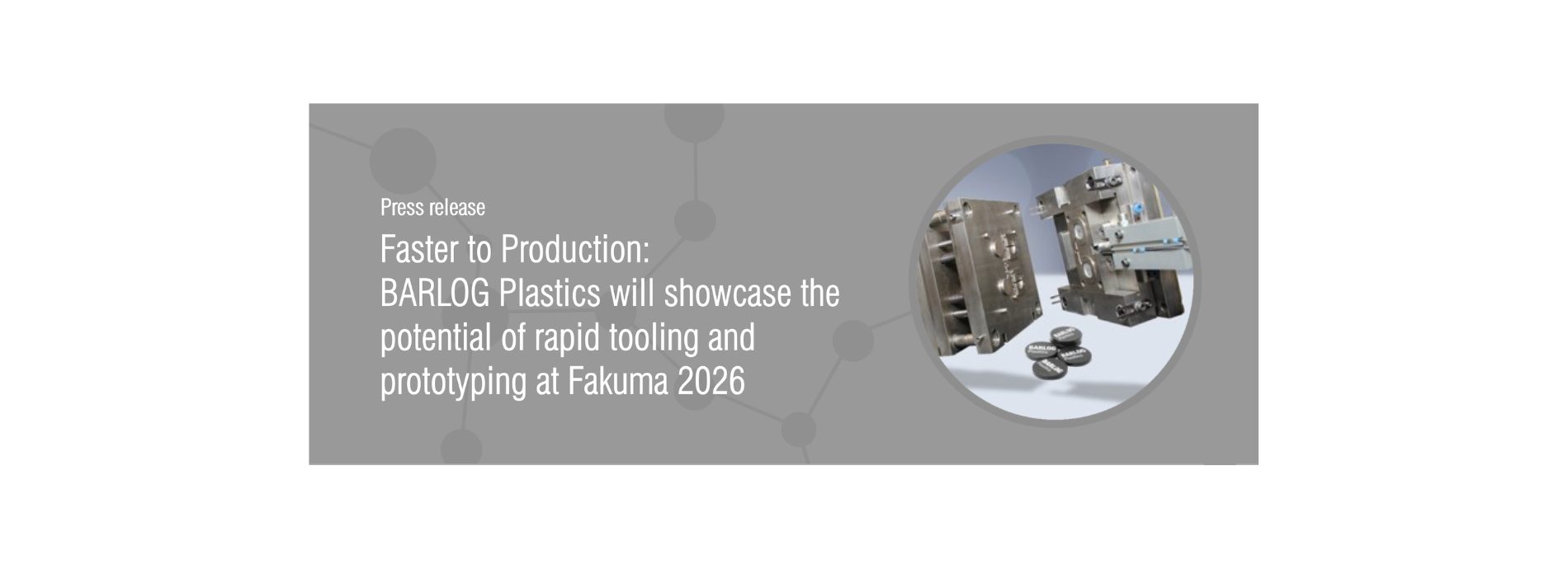
Faster to Production: BARLOG Plastics will showcase the potential of rapid tooling and prototyping at Fakuma 2026
Read more